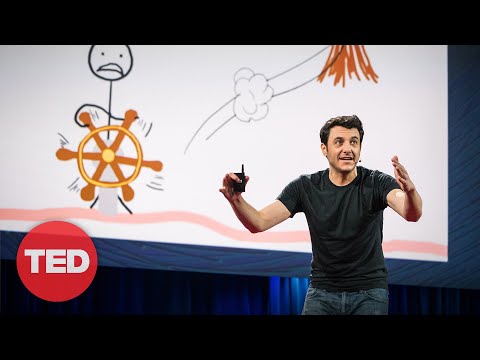
ちょうど背伸びできる難易度のコンテンツです。理想的な学習素材!
スクリプト抜粋
6 語ハイライト済みSo in college, I had this great system — I would put off my thesis for months, and then suddenly the deadline was three days away, and I'd pull three all-nighters in a row. Genius, right? My professor wasn't impressed. Neither was my future self. But somehow I kept doing it, project after project, year after year.
Now, most people are procrastinators in some way. But some of us are — let's call it — professionals. And for a long time I wondered why. Why can't I just start things like a normal person? Why does my brain actively fight me every time there's a deadline?
I started to picture it like this. Inside the procrastinator's brain, there's a rational decision-maker. Smart, responsible, knows what needs to happen. But he shares the steering wheel with an instant gratification monkey. The monkey has no concept of the future. The monkey only cares about what's fun right now. And most of the time, the monkey takes over. You try to figure out what you should be doing, but the monkey wants to watch YouTube for seven hours. The monkey wants to read Wikipedia pages about obscure dog breeds. The monkey wants to organize your desk for the fourth time today.
The rational decision-maker and the monkey fight for control. And if the task has a deadline, eventually, at some point, the panic monster wakes up — usually when you've run out of time. The panic monster only cares about one thing: consequences. Deadlines. Public humiliation. Failed classes. And when the panic monster wakes up, the monkey runs away, and the rational decision-maker finally gets to drive. That's when things finally get done.
Procrastinators are kind of — I don't know — in denial. We all think we've got more time than we actually do. "I'll start tomorrow." "Next Monday is when things really change." "Once summer hits, I'll focus." But the truth is, if you don't have a deadline, the panic monster never wakes up. And that's the real problem: not the deadline you miss, but the important things in life that have no deadline at all — the book you want to write, the startup, the relationship — those can get put off forever.
put off
I put off my thesis for months, and then suddenly the deadline was three days away.
意味
〜を後回しにする、先延ばしにする
ニュアンス解説
procrastinate の口語版。日常会話で多用され、「やらなきゃと思いつつ」のニュアンス。postpone よりカジュアル。
例文
Stop putting off that dentist appointment.
run out of
Suddenly, you realize you've run out of time.
意味
〜を使い果たす、尽きる
ニュアンス解説
時間・お金・材料などが「底をつく」ニュアンス。予想外に減っている感覚。
例文
We've run out of coffee. I'll go get some.
at some point
At some point, the panic monster wakes up, and that's when things finally get done.
意味
どこかの時点で、いずれ
ニュアンス解説
時期をぼかしつつ「いつかは」を示す表現。sometime より少し不確定感が強い。
例文
At some point, you have to make a decision.
figure out
I had to figure out what was actually stopping me from starting.
意味
〜を解明する、理解する
ニュアンス解説
もやもやした状態から答えに辿り着くプロセスを表す。understand が「分かっている状態」なのに対し、figure out は「考えて到達する」。
例文
I finally figured out how to use this software.
take over
The instant gratification monkey takes over the steering wheel.
意味
〜を引き継ぐ、支配する
ニュアンス解説
他者・他人の役割や場所を「引き受ける」または「占領する」ニュアンス。ビジネス・戦争・比喩いずれでも使える。
例文
She took over the project after her manager left.
kind of
Procrastinators are kind of — I don't know — in denial.
意味
なんか、ちょっと、まあ
ニュアンス解説
断言を避けて柔らかくする副詞句。ネイティブの会話に極めて頻出。sort of と同義。
例文
It's kind of complicated to explain.
このフレーズ、3日後も言えますか?
無料アカウントを作ると、保存した表現をクイズ形式で復習できます。忘却曲線に沿って「使える英語」に変わります。
クレジットカード不要 · 30秒で登録完了
Examples
他のコンテンツを見る
 Speech
Emma Watson · HeForShe UN Speech
国連 · 2014
 上級チャレンジSpeech
Steve Jobs · Stanford Commencement
Stanford · 2005
 TED
TEDSimon Sinek · How Great Leaders Inspire
TED · 2010
 TED
TEDMatt Cutts · Try Something New for 30 Days
TED · 2011
 Speech
Malala Yousafzai · UN Speech
国連 · 2013
 TED
TEDKelly McGonigal · How to Make Stress Your Friend
TED · 2013
 TED
TEDShawn Achor · The Happy Secret to Better Work
TED · 2011
 TED
TEDKen Robinson · Do Schools Kill Creativity?
TED · 2006
 TED
TEDBrené Brown · The Power of Vulnerability
TED · 2010
 TED
TEDAmy Cuddy · Your Body Language May Shape Who You Are
TED · 2012
 TED
TEDElizabeth Gilbert · Your Elusive Creative Genius
TED · 2009
 TED
TEDChimamanda Adichie · The Danger of a Single Story
TED · 2009
 Speech
J.K. Rowling · Harvard Commencement Speech
Harvard · 2008
 Speech
Michelle Obama · DNC Keynote Speech
DNC · 2016
 Speech
Randy Pausch · The Last Lecture
Carnegie Mellon · 2007
 上級チャレンジSpeech
Barack Obama · Farewell Address
Chicago · 2017
 上級チャレンジSpeech
Elon Musk · USC Commencement Speech
USC · 2014
 上級チャレンジSpeech
Oprah Winfrey · Stanford Commencement Speech
Stanford · 2008
 上級チャレンジSpeech
David Foster Wallace · This is Water
Kenyon · 2005
 上級チャレンジSpeech
Carl Sagan · Pale Blue Dot
NASA · 1990
 Vlog
VlogEmma Chamberlain · i got rid of (almost) everything
Vlog · Emma Chamberlain
 Podcast
MKBHD · iPhone 15 Pro Review
Tech · Marques Brownlee
 Podcast
Jenna Ortega · Hot Ones
Interview · First We Feast
 Podcast
Sydney Sweeney · Hot Ones
Interview · First We Feast
 TED
TEDCarol Dweck · The Power of Believing You Can Improve
TED · 2014
 TED
TEDDan Gilbert · The Surprising Science of Happiness
TED · 2004
 TED
TEDJulian Treasure · How to Speak
TED · 2013
 News
NewsVox · 2023, in 7 Minutes
News · Vox