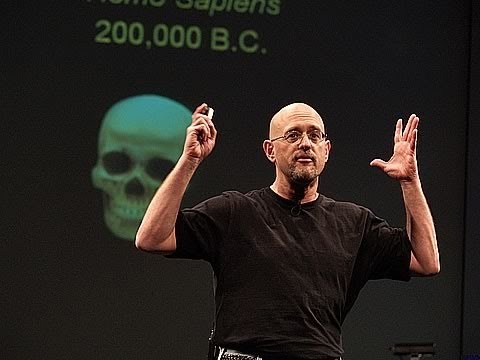
ちょうど背伸びできる難易度のコンテンツです。理想的な学習素材!
スクリプト抜粋
6 語ハイライト済みWhen you have 21 minutes to speak, two million years seems like a really long time. But evolutionarily, two million years is nothing. And yet, in that two million years, the human brain has nearly tripled in mass, and something remarkable has developed: a prefrontal cortex that allows us to simulate experiences before we have them.
Here's a puzzle that has driven my research. It turns out that lottery winners and paraplegics report similar happiness levels a year after their life-changing event. Both groups end up at about the same level of happiness, and this is the most surprising finding in my field. A year after winning millions, a year after losing the use of their legs — roughly the same happiness.
Why? As a matter of fact, we're remarkably good at this — we call it the psychological immune system. It's a system of largely unconscious cognitive processes that help us change our views of the world, so that we can feel better about the worlds in which we find ourselves. We come up with reasons to be happy with whatever outcome we get. "At least I learned something." "At least I met that person." "At least it wasn't worse."
Now, this doesn't make sense to most people. It doesn't make sense that we'd be happier with less choice, but the data shows we are. It doesn't make sense that people with fewer options sometimes report more satisfaction than people with many options. But that's what we find, again and again.
Money brings happiness up to a point. On the other hand, beyond that threshold, gains are minimal. Once your basic needs are met, additional income has a smaller and smaller effect on how you feel day-to-day. We're much better at manufacturing happiness than we think. The secret is that we don't need to travel to Hawaii or win the lottery. Natural and synthetic happiness are both real. And understanding that can change how we make decisions, how we set goals, and how we live.
turn out
It turns out that lottery winners and paraplegics report similar happiness levels a year later.
意味
〜だと判明する、結果的に〜となる
ニュアンス解説
予想と異なる事実が明らかになる時の定型。「意外にも」の含みがある。it turns out (that) の形で頻出。
例文
It turned out to be easier than we thought.
end up
Both groups end up at about the same level of happiness.
意味
結局〜になる
ニュアンス解説
意図せぬ結末を表す。Gilbert の研究では「予想と違う着地点」を強調する文脈で多用。
例文
We ended up at a tiny restaurant near the station.
make sense
It doesn't make sense that we'd be happier with less choice, but the data shows we are.
意味
筋が通る、理にかなう
ニュアンス解説
論理・直感に合うかどうかを評価する定型。肯定・否定どちらでも頻出。
例文
Your explanation finally makes sense.
as a matter of fact
As a matter of fact, we're remarkably good at this — we call it the psychological immune system.
意味
実のところ、実際には
ニュアンス解説
前の発言を強化・修正する時の挿入句。in fact / actually とほぼ同義でフォーマル寄り。
例文
As a matter of fact, I've been there three times.
on the other hand
Money brings happiness up to a point. On the other hand, beyond that threshold, gains are minimal.
意味
一方で
ニュアンス解説
対比する意見や事実を導入するフォーマル寄りの接続句。プレゼン・論文・討論で頻出。
例文
The city is exciting; on the other hand, it's exhausting.
come up with
We come up with reasons to be happy with whatever outcome we get.
意味
〜を思いつく、考え出す
ニュアンス解説
アイデア・理由・言い訳を「捻り出す」ニュアンス。think of より能動的・創造的。
例文
He came up with a perfect excuse.
このフレーズ、3日後も言えますか?
無料アカウントを作ると、保存した表現をクイズ形式で復習できます。忘却曲線に沿って「使える英語」に変わります。
クレジットカード不要 · 30秒で登録完了
Examples
他のコンテンツを見る
 Speech
Emma Watson · HeForShe UN Speech
国連 · 2014
 上級チャレンジSpeech
Steve Jobs · Stanford Commencement
Stanford · 2005
 TED
TEDSimon Sinek · How Great Leaders Inspire
TED · 2010
 TED
TEDMatt Cutts · Try Something New for 30 Days
TED · 2011
 Speech
Malala Yousafzai · UN Speech
国連 · 2013
 TED
TEDKelly McGonigal · How to Make Stress Your Friend
TED · 2013
 TED
TEDShawn Achor · The Happy Secret to Better Work
TED · 2011
 TED
TEDKen Robinson · Do Schools Kill Creativity?
TED · 2006
 TED
TEDBrené Brown · The Power of Vulnerability
TED · 2010
 TED
TEDAmy Cuddy · Your Body Language May Shape Who You Are
TED · 2012
 TED
TEDElizabeth Gilbert · Your Elusive Creative Genius
TED · 2009
 TED
TEDChimamanda Adichie · The Danger of a Single Story
TED · 2009
 Speech
J.K. Rowling · Harvard Commencement Speech
Harvard · 2008
 Speech
Michelle Obama · DNC Keynote Speech
DNC · 2016
 Speech
Randy Pausch · The Last Lecture
Carnegie Mellon · 2007
 上級チャレンジSpeech
Barack Obama · Farewell Address
Chicago · 2017
 上級チャレンジSpeech
Elon Musk · USC Commencement Speech
USC · 2014
 上級チャレンジSpeech
Oprah Winfrey · Stanford Commencement Speech
Stanford · 2008
 上級チャレンジSpeech
David Foster Wallace · This is Water
Kenyon · 2005
 上級チャレンジSpeech
Carl Sagan · Pale Blue Dot
NASA · 1990
 Vlog
VlogEmma Chamberlain · i got rid of (almost) everything
Vlog · Emma Chamberlain
 Podcast
MKBHD · iPhone 15 Pro Review
Tech · Marques Brownlee
 Podcast
Jenna Ortega · Hot Ones
Interview · First We Feast
 Podcast
Sydney Sweeney · Hot Ones
Interview · First We Feast
 TED
TEDCarol Dweck · The Power of Believing You Can Improve
TED · 2014
 TED
TEDTim Urban · Master Procrastinator
TED · 2016
 TED
TEDJulian Treasure · How to Speak
TED · 2013
 News
NewsVox · 2023, in 7 Minutes
News · Vox